

Search & AI Visibility
Why AI systems often struggle to interpret large websites – and what to do about it
| Key takeways |
|---|
|
A phrase we’re hearing more and more from clients is: “All the information is there, why isn’t it being cited by AI?”
The answer is: simply having content on your site doesn’t guarantee that AI can ‘see’ it. AI systems don’t interpret websites like we do – they analyse it for signals that stems from clear, structured information relevant to user search queries.
In this article we’ll explore how AI systems search for content, why they operate like this, and how you can structure your content to be more visible to AI.
The hidden tension inside enterprise content ecosystems
Every enterprise organisation has an in-built operational challenge: they need to wear too many hats at once. Often, they must juggle:
- multiple products
- multiple audiences
- multiple campaigns
- multiple priorities
- multiple stakeholders
The result? Pages become overloaded with competing information and lack a sense of clarity and consistency.
This isn’t a great situation; it negatively impacts user navigation, and AI systems know this. Beyond a bad user experience, this approach leads to:
- weak information hierarchy
- diluted signals
- fragmented discoverability
- inconsistent AI interpretation.
AI systems reward prioritisation and clarity more than comprehensiveness alone.
How AI systems search for content
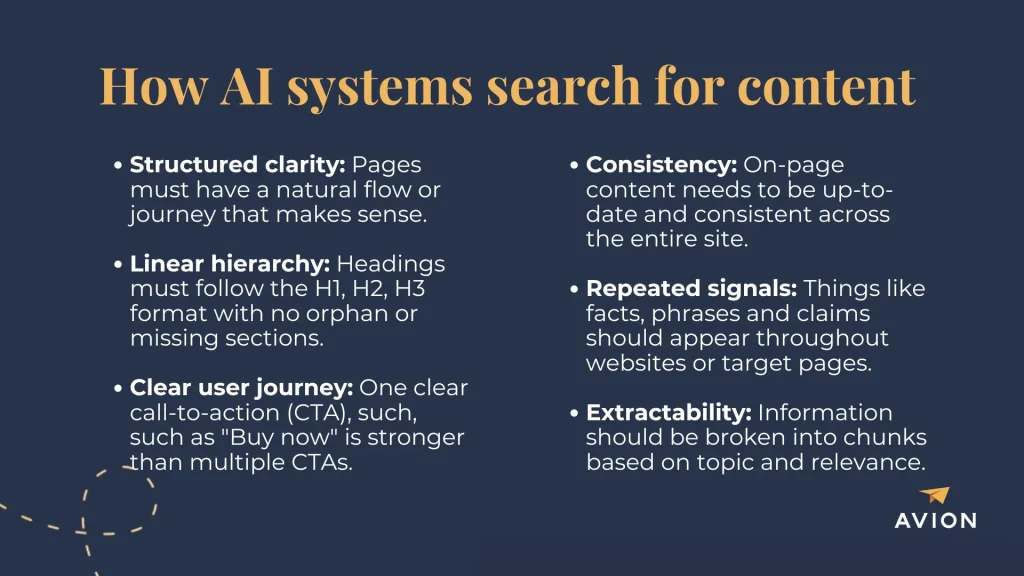
AI systems look for specific content patterns, such as layouts, structures, or word combinations to identify whether the content is relevant to the search query. To increase your site’s AI visibility and citations, your website needs:
- Structured clarity: Pages must have a natural flow or journey that makes sense.
- Linear hierarchy: Headings must follow the H1, H2, H3 format with no orphan or missing sections.
- Clear user journey: One clear call-to-action (CTA), such, such as “Buy now” is stronger than multiple CTAs.
- Consistency: On-page content needs to be up-to-date and consistent across the entire site.
- Repeated signals: Things like facts, phrases and claims should appear throughout websites or target pages. What sets these elements apart is that they’re verified, backed up by stats, and specific.
- Extractability: Information should be broken into chunks based on topic and relevance.
8 reasons your website content isn’t showing up in AI search
- Buried answers: your content doesn’t answer the question of the page, or the heading it sits under. The language is either vague or leans too heavily into branded messaging.
- Competing priorities: the content on the relevant page is covering more than one topic, leading to confusion when AI accesses it.
- Promotional clutter: too much focus on offers or specials. This can fragment information on a page, especially if it’s drawing attention and clicks away to another page.
- Fragmented ecosystems: pages that don’t follow a natural rhythm or flow. This can be seen in pages addressing multiple points instead of a single topic. This also extends to page families covering unrelated topics.
- Duplicated information: sets of pages displaying the same text and topics, like specific product information. A common occurrence on larger websites.
- Inconsistent structures: having landing or product pages structured in different ways can impact how users navigate and AI scours your site.
- Weak schema and metadata: schema and metadata should clearly describe the page contents or product, include a keyword, and keep to the character count.
- Overloaded pages: too much content means important information gets buried. Keep it lean with key information above the fold.
Why AI often surfaces non-owned sources instead of official brand websites
A 2025 report from Profound shows that ChatGPT cites Wikipedia 7.8% of the time in its results. The same report highlights that Google AI cites Reddit 2.8%. It may seem counterintuitive, but the truth is that AI is attempting to be as objective as possible with this approach. Instead of going directly to the ‘source of truth’, AI prioritises third-party sites.
Common sites include:
- Affiliate or competitor sites
- Wikipedia
- Comparison websites
- Review blogs
- Educational explainers
There are several reasons AI picks these sources over an actual enterprise site:
They answer questions directly
- Having clear answers, whether in on-page content or in FAQ sections, is key for AI systems.
- Review blogs and explainers get to the point; this bumps up their relevance to AI systems
What sets third-party sources apart is the way they display content. Sites like Wikipedia format in a highly organised, encyclopaedic hierarchy. This is the kind of page structure AI models are trained to easily read and summarise.
They prioritise extractable summaries
AI is constantly looking for the easiest way to find the information it needs. Think about how Google presents its AI overview when you search for a topic. It always shows an automatically generated summary at the top of the search results.
You can help boost your page’s visibility by:
- Having extractable summaries
- Highlighting paragraphs in rich text
- Separating key sentences from the body copy.
Formatting your content like this makes it easier for AI systems to find and replicate.
They’re straight-talkers
AI systems are focused on efficiency. Sites such as Reddit present relevant information upfront and without mixed messages – like having multiple subjects in one section or paragraph. This kind of clarity is rewarded by AI systems.
They support comparison and reduce uncertainty
Comparison sites tend to be highly structured, making it easier for AI systems to analyse. They’re also free of brand and marketing language. This means less ambiguity and fewer context shifts.
What this all means is being the source of truth no longer guarantees being the source AI chooses to reference. This isn’t necessarily a problem on its own. The issue is many brands are absent from the informational layer shaping customer decisions.
Why helpful content is becoming more visible than conversion content
AI systems are often better at surfacing content that helps users make decisions than content designed primarily to drive conversion. Brand and marketing content doesn’t always deliver the response AI is looking for.
What enterprise brands are still prioritising
Because of the need to focus on business growth, it’s understandable that enterprise brands are still in a conversion mindset. This isn’t necessarily a bad thing; enterprise brands are often selling an identity. But it becomes an issue when GEO strategy isn’t applied to:
- conversion pages
- campaign landing pages
- promotional pathways.
What AI systems are rewarding
In May 2026 Google announced that AI-generated answers, not keywords, will be the future of marketing and advertising. As we’ve seen, AI systems are placing greater authority on verifiable sources. AI systems are giving prominence and visibility to:
- calculators
- FAQs
- explainers
- decision-support tools
- educational content
- concise summaries
- comparison structures
- “At a Glance” style content.
These content structures display the most relevant content clearly, helping the user make informed decisions. Thought and consideration is put into how the information is displayed on product pages, the content’s value to the user, and what the CTA is.
Before deciding to purchase, AI users are often:
- researching
- validating
- comparing
- reducing uncertainty
They are gravitating towards scannable content like quick explainers and FAQs because they break down key information into quick summaries.
Because users are valuing these types of pages, AI systems are too. AI overviews are now used by search engines when displaying search results to mirror this structure.
GEO isn’t just about making product pages visible. It’s about helping brands participate in decision-making ecosystems more effectively.
So, what should enterprise teams do to make their content more visible?
What winning organisations do differently
The good news is there are clear and practical solutions to these issues. Being late to the game doesn’t mean you can’t win. The key takeaways:
Start with strategy
- Prioritise key user tasks: what action do you want the user to take?
- Improve metadata and schema consistency: make sure your backend information faithfully describes your frontend. Be mindful of the character limit.
- Reduce signal fragmentation: focus on one audience completing one action per page. Don’t try to send users in multiple conflicting directions.
Update your page structure
- Structure pages around extractable answers: elevate key text, include breakout boxes and bullet points.
- Simplify competing messages: separate the page into sections that naturally flow into each other. If content sections are too different from each other, create a new page for one of those sections.
- Strengthen hierarchy: create page templates for different page types and apply across the whole website.
- Create scalable content patterns: create content segments and snippets for quick and easy digestion and insertion across different digital channels.
Optimise for people and AI
- Design “at-a-glance” modules: these are an easy way to highlight key benefits or features to both users and AI systems. You identify the key benefits of a product or service and separate them from the body copy in their own component. AI systems and customers will be easily able to find it.
- Structure ecosystems for both humans and machines: make your content clear, structured, and accurate.
- Invest in educational and decision-support content: this will give your content increased authority, greatly improve visibility and position you as an industry leader in the topic.
Winning organisations are increasingly designing ecosystems for interpretability. A good rule of thumb is: if your least tech-savvy family member can read and interpret your page, so can AI.
Discoverability is becoming an ecosystem challenge
Focusing purely on SEO is no longer the approach. AI growth means discoverability is:
- a structural challenge
- a prioritisation challenge
- a content architecture challenge
- a digital clarity challenge
- an operational challenge.
Viewed like this it feels there’s a lot to solve all at once. If we’ve learned anything, it’s that GEO strategies should be the foundation of all enterprise campaigns. To be competitive, you need to update your strategy.
The organisations that perform best in AI are those that reduce complexity and support decision-making. These will be the organisations that make information:
- easiest to interpret
- easiest to compare
- easiest to prioritise
- easiest to extract
- easiest to trust.
Operational examples
Now let’s see all this in practice! See practical examples below showing how small GEO-focused improvements can make a huge difference.
AI surfaces third-party sources instead of official brand websites
The situation
An B2B software provider items isn’t appearing in AI search results. Despite having dedicated product pages, they’re struggling with visibility. If they are visible via AI search at all, the brand is showing up on third-party sites where reviewers are asking “which one is right for me?”.
The solution
Clearly answer who the product is for (narrow the most valuable audience segment/s as much as possible), how it compares to competitors and why it’s best for the customer. This comparative content is what AI is currently missing on-site, which is why it’s pulling the comparison from third parties instead.
Take note of comparison sites too. Include elements like tables (for pricing, specifications and features) and brief rundowns of the product under its title. This will help content be perceived as useful and relevant.
Information is present, but AI search doesn’t prioritise it
The situation
- An insurance provider is launching a new policy for customers. This policy contains a lot of new features, technical information and legal jargon.
- Industry regulations and sticking with old strategies has seen this product page swell in size with overly technical information. The content is in paragraphs without any components breaking up the text, and there are minimal headings throughout. It’s not that the information is wrong or missing – it’s that AI has nothing to grab onto.
The solution
- Use breakout boxes and components to highlight key features and benefits.
- Conduct a content audit to find outdated information and unnecessary terminology to remove it from the page.
- Overhaul the page structure to incorporate search terms and assist with navigation.
- Place insurance policy information in a table (price, features, etc.) so it’s easier to find.
- Include a comparison tool if possible so customers can see how the policy is different to others you (or your competitors) are offering.
Simple answers to FAQs still don’t show up
The situation
A retailer isn’t appearing in search results. They have a unique brand identity and well-regarded product offering with positive reviews. However, they’re being outranked by competitors, and any traffic they get to their site bounces.
Store operators are at a loss as to why, since all the information exists. The issue is that the hotel leads with internal brand language instead of service-related content, the keywords that guests use when searching on AI platforms. AI can’t match the store’s content to a customer’s plain-language query, even when the answer is technically on the page.
The solution
- Conduct a GEO content audit focused on language, not layout.
- Map brand-specific terminology to customer-facing language throughout the page.
- Reorganise content into a simplified structure that focuses on clarity.
- Create ‘at a Glance’ components that highlights key facts.
Improve clarity and you’ll improve visibility
If there’s one point to be taken from this article it’s this: clarity and structure are integral to winning at GEO.
Creating helpful and decision-focused content that gets to the point and offers legitimate value to customers is what’s winning. As AI usage continues to grow this approach will only be more relevant.
Enterprise organisations who adapt to this approach have the best chance to compete in a very crowded environment.
To learn more about AI visibility, read our 2026 whitepaper, Bridging the AI Visibility Gap.
Image credit: Illustration on Magnific.

About the author
Natalie is a content strategist and co-founder of Avion, helping organisations shape clear, consistent brand narratives in an AI-driven world.
Recent articles

The next war isn’t about oil, it’s about land for data centres
The future of AI isn’t just about smarter models. It’s about the infrastructure behind them.

The real reason enterprise website projects run over budget
It’s rarely scope creep. Budget overruns on enterprise websites usually trace back to one thing: when content decisions get made.

Why content teams can’t hire their way out of delivery problems
When content delivery stalls, hiring can look like the obvious fix. But it often misses the real problem.

Our hot takes, straight to your inbox
Subscribe and join hundreds of readers just like you.