

Customer Experience & Journey Design
Why enterprise content is hard to measure, yet so critical to business performance
| Key takeaways |
|---|
|
If you are a digital or CX leader in a large organisation, you are likely feeling a very specific type of pressure right now. As budgets tighten, the expectation to justify every single dollar of investment has never been higher.
Attribution expectations are becoming more demanding, and leadership teams want to see a direct line between digital spend and commercial outcomes.
It creates a difficult internal tension. CEOs are right to care about top-line revenue and bottom-line profitability. But friction arises because enterprise organisations often expect content to behave like traditional marketing campaigns.
They want to see an immediate transactional spike. They want to point to a specific page or a single piece of copy and isolate its exact contribution to a conversion.
But enterprise content doesn’t work that way.
Unlike targeted ad campaigns, the true impact of enterprise content is incredibly difficult to isolate cleanly. It doesn’t live in a silo, and it rarely drives an instant, single-click purchase.
Force content teams to prove their ROI using campaign metrics, and you miss the actual commercial value of what they do. You end up chasing short-term, easily measurable wins while ignoring the overall health of your digital ecosystem.
Content is infrastructure, not marketing
When I speak to people about the true commercial value of enterprise content, I ask them to reframe how they look at it. Good content behaves much more like infrastructure than traditional marketing activity. Although its impact doesn’t always show up neatly in tomorrow’s reporting, it shapes business performance every day.
Here are six ways content provides the backbone for a strong digital experience:
- Usability: Ensuring users can navigate interfaces and complete tasks without friction or cognitive overload.
- Discoverability: Structuring information so it naturally surfaces for both customers and search algorithms.
- Customer confidence: Using clear, transparent language that removes hesitation during high-stakes decisions.
- Support demand: Answering basic questions at the point of interaction to reduce avoidable calls and chats.
- Operational efficiency: Streamlining how internal teams create, manage, and scale experiences without rebuilding layouts from scratch.
- Journey completion: Ensuring customers can move from initial intent to final execution without dropping out.
The challenge is that enterprise organisations often prioritise what’s easiest to measure, rather than operational clarity and digital ecosystem health.
A single content update might not shift a quarterly report. But hundreds of deliberate improvements across the digital channels can build on one another to create a meaningful advantage over time.
The operational fallout of temporary fixes
CEOs are right to care about KPIs. They need to know what’s changing each month. But when teams are pushed to chase metrics over meaning, efforts can lead to messier outcomes long-term.
Problems show up across platforms in predictable ways:
- Fragmented customer journeys: Users trip over different tones, layouts, and terminology as they move between sections of the site.
- Duplicated content: Different teams unknowingly create variations of the same help articles or product explainers, cluttering the platform.
- Inconsistent messaging: Conflicting information coexists on the same platform, quietly eroding customer trust.
- Reactive publishing: Teams operate in a perpetual state of putting out fires, rushing text through just to hit arbitrary launch deadlines.
- Unnecessary support demand: Poorly explained features or hidden details force customers off the page and straight into the call centre queue.
- Rework between teams: Designers, developers, and writers constantly pass assets back and forth, burning hours fixing misaligned layouts and copy.
Instead of managing a website as one strategic asset, different teams end up running their own race. Effectiveness within the organisation falls apart. If outcomes such as visibility, conversion, and brand sentiment aren’t reviewed together, enterprises may end up with a site that ranks well but doesn’t make sense.
UX may solve the task, SEO may solve visibility, and design may shape the experience. But content is what makes the whole thing clear. When content is treated as a late-stage campaign task, it can’t properly connect customer needs, search intent, technical constraints, and business goals.
That is where the cost of temporary fixes starts to escalate. Over time, enterprises are left with duplicated pages, inconsistent journeys, rising support demand, and expensive rework that could have been avoided earlier – and metrics that represent these issues are just as meaningful as the vanity metrics that many organisations chase.
Discoverability is now a clarity problem
Modern search and AI answer engines have flipped the script. They don’t just look for keywords anymore; they reward deep consistency, clarity, and well-connected digital experiences.
Isolated teams publishing fragmented updates create contradictions and gaps that weaken discoverability. Search algorithms and large language models crawl your entire domain to understand what you do. When they hit conflicting details, it becomes harder for them to understand, trust, and surface your content.
What’s worse is that the standard corporate response to falling traffic is to produce more content. I see enterprise teams fall into this trap constantly.
The reality is that pumping out more volume rarely makes an organisation easier to understand. Usually, it just adds to the noise, introduces more inconsistency, and buries the information customers actually need.
Discoverability isn’t just a technical issue. It’s a direct reflection of operational clarity. With AI summaries and search previews, users can form opinions, build trust, and make decisions before they ever reach your website. That means your content is shaping market perception long before a measurable conversion exists.
To win here, organisations need to connect UX, SEO, GEO and content from the start. UX helps people complete tasks, SEO and GEO help people find and understand information, and content makes the experience clear. When these areas are siloed, the digital experience fractures.
Success is no longer about how many new pieces were launched or the number of pages that were updated per month. Senior leaders should be thinking about how effectively audiences and machines can understand content that’s already in place.
A better way to measure platform health
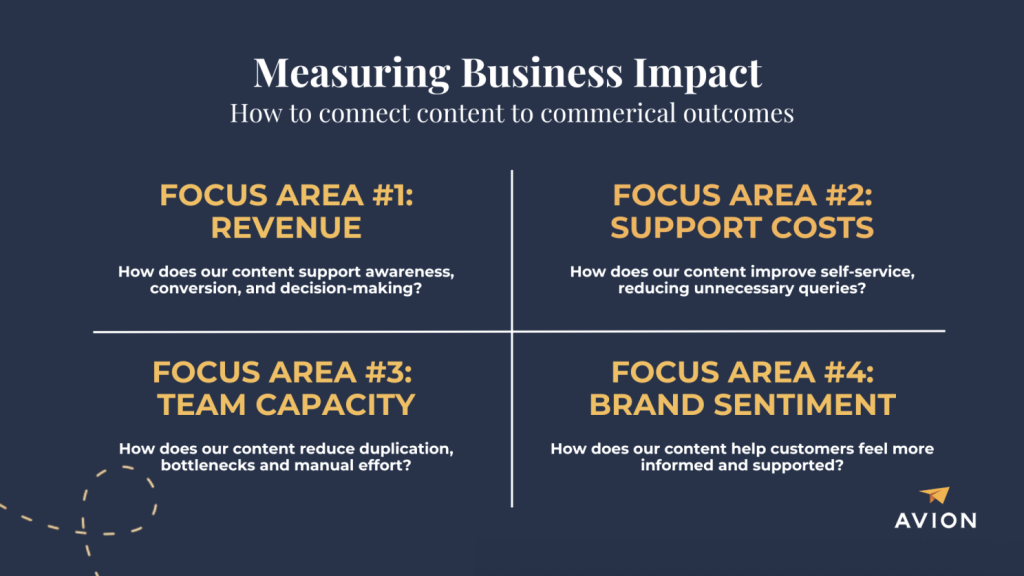
When clients ask us about ROI, we explain that we look at improvements across 4 key focus areas.
How do leaders communicate progress internally when improvements are cumulative rather than isolated? This is a massive barrier for digital teams. Legacy reporting forces leaders to draw a straight line between a single content change and an immediate sale. But in a complex business environment, that approach does not reflect reality.
The real value of digital work lies in how well an organisation performs. Mature enterprises recognise that customer journeys span multiple touchpoints.
At Avion, rather than looking at isolated numbers, we benchmark and examine four key areas to determine content success:
- Driving revenue: How does our content support awareness, conversion, and decision-making?
- Reducing support costs: How does our content improve self-service, reducing unnecessary queries?
- Augmenting team capacity: How does our content reduce duplication, bottlenecks and manual effort?
- Improving brand sentiment: How does our content help customers feel more informed and supported?
The best breakthroughs happen when we define several metrics from each focus area to measure on an ongoing basis.
This gives DX, CX, and content leaders a clear, data-backed way to:
- demonstrate progress
- justify investment
- prioritise work
- communicate uplift internally
- show cumulative improvement over time.
This approach matters because it empowers teams to stop second-guessing whether a single page generated a specific dollar amount on its own. We may not be able to attribute every uplift directly to one content change, but we can clearly demonstrate the effect of digital content over time.
Rethinking how content is evaluated
When budgets tighten and every investment comes under scrutiny, content is often pushed to prove its value in simple terms. But enterprise content rarely creates ROI through one isolated moment. Impact should be assessed in the context of the entire digital experience: how easily people find information, understand their options, and feel confident in what they are doing next.
The organisations that understand this will be better placed to make smarter decisions about where to invest, what to improve and how to explain the value of content internally.
For senior leaders, the opportunity is to go beyond asking: “Did this page convert?” Instead, let’s start cross-examining key areas to find out: “Is our content making it easier for customers to find us, choose us, trust us and complete the tasks they need help with?”
Image credit: Illustration by topconcept on Magnific.

About the author
Natalie Khoo is a content strategist and co-founder of Avion, helping organisations shape clear, consistent brand narratives in an AI-driven world.
Recent articles

Why content teams can’t hire their way out of delivery problems
When content delivery stalls, hiring can look like the obvious fix. But it often misses the real problem.

Why enterprise content is hard to measure, yet so critical to business performance
Enterprise content is hard to measure, but its impact is impossible to ignore. Discover why it’s critical to long-term business performance.

The problem with treating GEO and conversion separately
Getting surfaced first and fixing performance later often means doing the same work twice.

Our hot takes, straight to your inbox
Subscribe and join hundreds of readers just like you.