

Search & AI Visibility
No internet. No ChatGPT. Now everything is different – except healthcare content

When I got my first period, there was no internet. There was Dolly’s sealed section, a friend who’d already gone through it, and maybe your mum if periods weren’t a taboo subject in your house.
When I went through IVF, in 2021 and 2022, there was no ChatGPT. I scoured the internet for answers instead.
Two of the most disorienting experiences a woman can go through, decades apart. Both left me piecing things together from whatever scraps I could find.
I’ve spent years building a content strategy agency, so this isn’t a throwaway observation. A lot has changed for the everyday girl wanting to know what is happening with their body as a teenager. And for women wanting to know what’s happening with their body during five rounds of IVF. Since 2022, ChatGPT has shown up and started doing the explaining instead.
I have a lot of reservations about generative AI. But there’s one thing I think it’s done that nobody in healthcare marketing wants to say out loud: it’s made the gap between patient and doctor more equitable than it’s ever been.
And most healthcare providers are nowhere near ready for what that means for them.
How I dealt with my IVF questions
I spent hours a day trying to work out how many eggs I might get. Why my cycle wasn’t responding the way the textbook said it should. Why I’d had two miscarriages and what, if anything, that meant for the next round.
I had 15 minutes (maybe 30 max) with my specialist every few weeks. So I filled the rest of the time the only way I could: crawling forums, asking strangers questions in Facebook groups, comparing needle dosages, surgery types, and recovery times. Was my progesterone meant to be pessaries or something else? (Wait, what’s a pessary anyway?) Was that normal? Someone in a group would mention they’d been put on prednisone and I’d spend the next hour wondering why I wasn’t. Was my clinic really doing everything they could, or was my case different?
The brochures didn’t help either. Every one of them defaulted to “normal” circumstances, like a vaginal birth, not a planned caesarean. Nothing acknowledged that my path to a baby involved a donor, which is its own layer of navigating a healthcare and social system that mostly assumes a family looks a certain way and just doesn’t say much about the families that don’t. Content was written for “IVF patients” as a category. I was left trying to figure out the gaps myself late at night, always convinced I was missing something that would matter.
A healthcare gap well documented
What I was living through has research behind it, and it isn’t great. The average doctor’s appointment runs somewhere between 15.7 and 17.4 minutes, with patients and doctors each getting roughly five minutes of actual talking time. Primary care physicians are commonly expected to see between 18 and 30 patients a day, in slots as short as ten to 20 minutes each. In that window they’re meant to take a history, examine you, land on a diagnosis, explain a treatment plan, and write it all up.
It’s not that doctors don’t care. GPs surveyed about their own shrinking appointment windows overwhelmingly predicted the fallout themselves: Around half feared patients were left feeling unheard or undervalued, and losing confidence in their care as a result. That’s clinicians saying there’s a problem before their patients even call it out.
So people did what I did. They started looking elsewhere. And “elsewhere” has moved from Facebook groups and forums to generative AI.
More than 5% of all ChatGPT messages globally are now about healthcare (that’s billions of conversations a week) and more than 40 million people ask it a health question every single day.
A December 2025 Rock Health survey found that a third of US adults have now used an AI chatbot for health information. This is double the year before, and top searches are around treatment options, symptoms, medication, and side effects.
Nowhere is that truer than fertility. There’s now a growing body of clinical research specifically testing whether ChatGPT can hold its own on IVF questions, benchmarked against reproductive medicine’s own professional guidelines. The most rigorous version of that study is honest about where things stand: physician answers still beat AI answers on quality, clearly and consistently. But AI wasn’t far behind, and it was miles ahead of what a patient can piece together alone from forums at midnight, which is what I was actually competing against.
Generative AI: A blessing and a curse
This is where I think a lot of people (healthcare providers especially) get stuck on the wrong half of the argument. They see the ChatGPT numbers and panic about misinformation, liability, patients self-diagnosing. All fair concerns. But they miss that this ship left the dock a while ago, and the alternative was never “patients wait patiently for their next appointment.” The alternative was Facebook groups, forums, and me at my kitchen table trying to work out if two miscarriages meant something was fundamentally wrong with me.
During IVF, I ended up with several mosaic embryos. This means chromosomally abnormal. It was on me to decide whether to transfer the embryos and see if they worked out, or let them go. What would’ve helped was the ability to understand the abnormalities on my report well enough to make an informed decision.
If I had ChatGPT back then, I could have uploaded the report and had each result explained back to me in plain English, at whatever hour I was awake.
While I wouldn’t have taken its response as a definitive yes or no, at least I’d have better understood what I was choosing.
What’s changed since I did IVF isn’t that patients now have access to information. We always had access to information, or at least a version of it. But now, patients have access to information that talks back, in a language they can understand. It’s a genuine blessing. That said, it’s also a curse, because there are always going to be specific factors like your actual bloodwork, history, and protocol it won’t know as much about.
The gap between helpful-in-the-moment and precise-and-personalised is where healthcare providers now have to live. And it’s an opportunity most are ignoring.
The new job of a doctor is synthesis, not gatekeeping
There has always been a doctor-patient communication gap. Many people like me unfortunately get handed a protocol, are told to trust it, and left wondering what wasn’t said. What’s different now is that patients have usually asked the internet for help. They’re not walking in blank.
This means providers will stand out for their ability to take what patients have already half-read on their phone at midnight and tell them, specifically, what it does and doesn’t apply to them, and why. Why this protocol over that one. Why their case is different to the forum post they found at 1am that scared them. That’s a whole job changing shape because providers no longer have all the information while patients have none. Why this protocol over that one. Why their case is different to the forum post they found at 1am that scared them. That’s not a small shift. That’s the whole job changing shape.
And that job doesn’t happen in a 15-minute appointment. It happens in between appointments. The content providers put out in the world for patients is what fills the hours between visits, whether they like it or not.
Content that meets people where they are, not content that explains “the process”
For years, healthcare content strategy has meant the same three-step explainer:
- Here’s what a cycle looks like.
- Here’s what to expect.
- Here’s what happens next.
It’s generic, sequenced, built for an average patient who doesn’t exist.
That’s not good enough anymore, and I’d argue it’s actively working against providers who use it. Good content used to be about educating someone on the process. Now it needs to explain a specific protocol while putting a patient’s actual circumstance first: the donor-conceived family, the planned caesarean, the second miscarriage, the dosage question that’s kept someone up at night. Every forum post I turned to during my own rounds existed because nothing better had been written for my exact situation, and that’s the gap misinformation fills too, when trustworthy, specific content isn’t there first. The providers who build content libraries deep enough to speak to those specifics are the ones who’ll be there when someone asks an AI assistant a very particular question, and it’s their language, their protocol logic, their patient stories that get pulled into the answer. The ones still publishing the generic three-step explainer won’t be in the conversation at all.
This is also the mechanism behind what people are now calling generative engine optimisation: being the source an AI system trusts enough to cite, not just a page a person might click. I’d rather not reduce this to a marketing tactic, but the commercial upside is real. Improving brand awareness, driving revenue, and building trust are all by-products of doing something that actually matters: closing the gap that misinformation would otherwise fill, giving people information that speaks to their actual circumstance, not a brochure written for an average patient who doesn’t exist.
A real-life review: Private maternity hospital websites
I had my twins at Epworth. The care itself was excellent. The communication leading up to it wasn’t – and looking back at their website now, with a content strategist’s eye instead of a first-time mum’s, I can see exactly why.
One of the first questions a pregnant woman gets asked is “do you know where you’ll go?” In my experience, it’s one of the most daunting decisions in the whole process – you want the best care, in the highest-stakes moment of your life, and you’re often making that call with very little to go on.
Sometimes the decision comes down to location, cost, or which obstetrician you’ve already chosen – that’s how I ended up at Epworth. But when a patient does have a real choice, hospitals need to win that trust. Not with a facilities tour, but with evidence that they understand their specific journey, and have handled circumstances like hers before.
So I looked at the homepages of three private maternity hospitals in Melbourne to see how they’re doing it:
Screenshots below have all been captured on 7 August 2026.
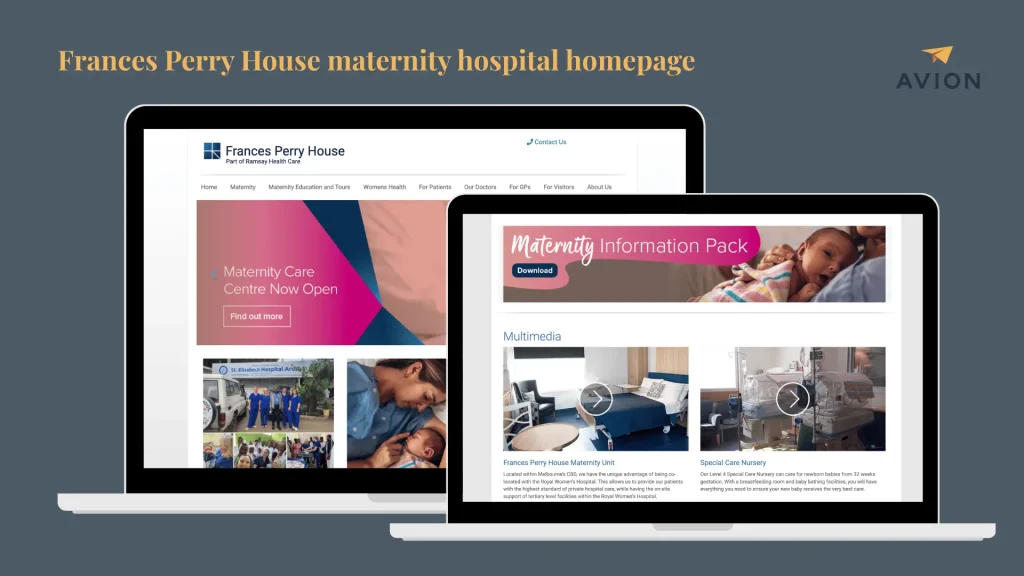
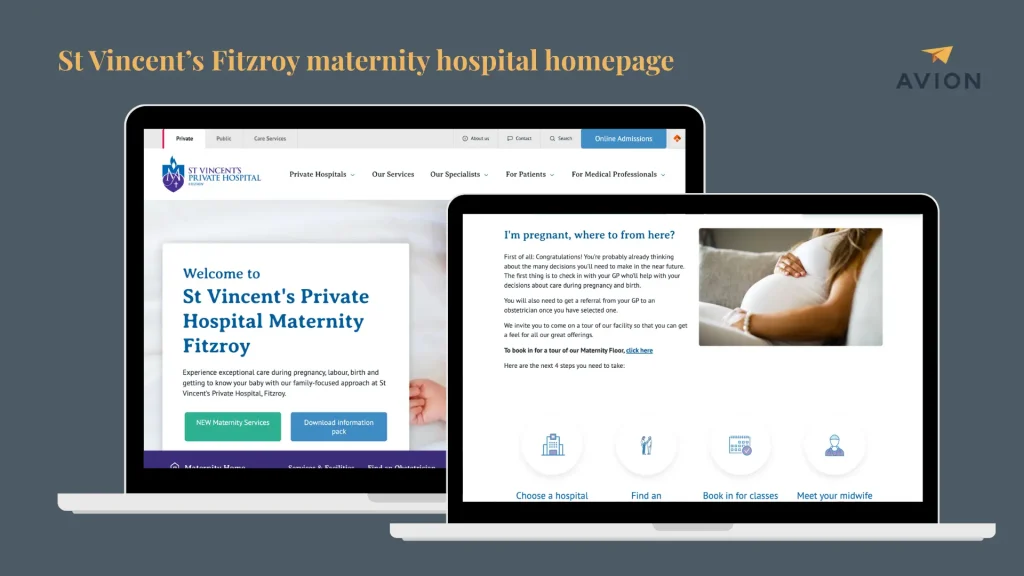
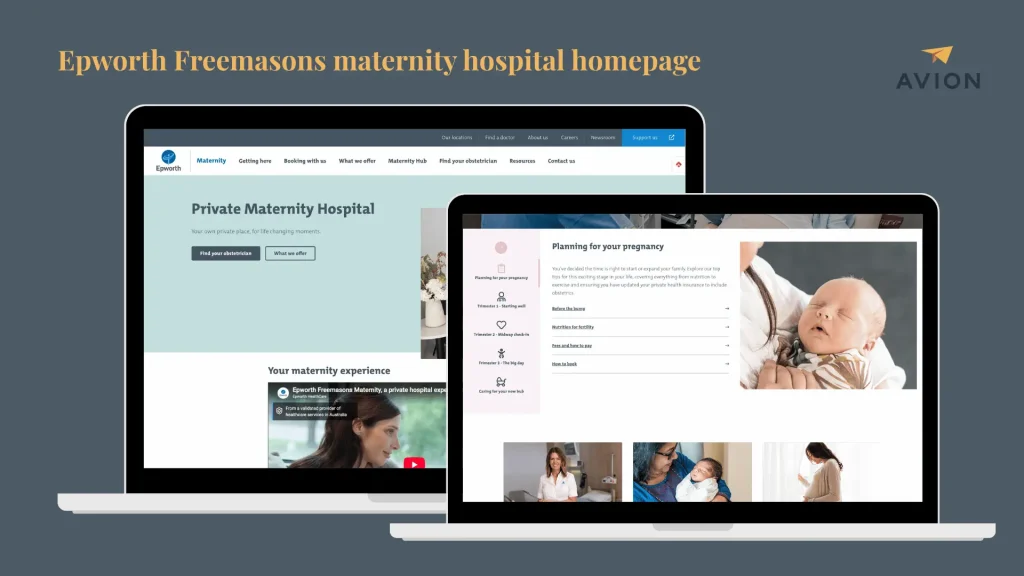
Everything reads pretty basic, unfortunately. All three default to the hospital as hero: look at our facilities, look at our reputation, download our generic info pack. Epworth even has a section called “Planning for your pregnancy” that I’ve read in full, and everything in it is something you could find in any book or on any other hospital’s website. I don’t think that type of content should disappear. Plenty of prospective patients genuinely just want to book a tour or preview the rooms, and that’s a legitimate need. But building most of your homepage around “look at us,” with nothing underneath it to prove you understand their situation, is a missed opportunity to build the trust that actually gets a patient over the line.
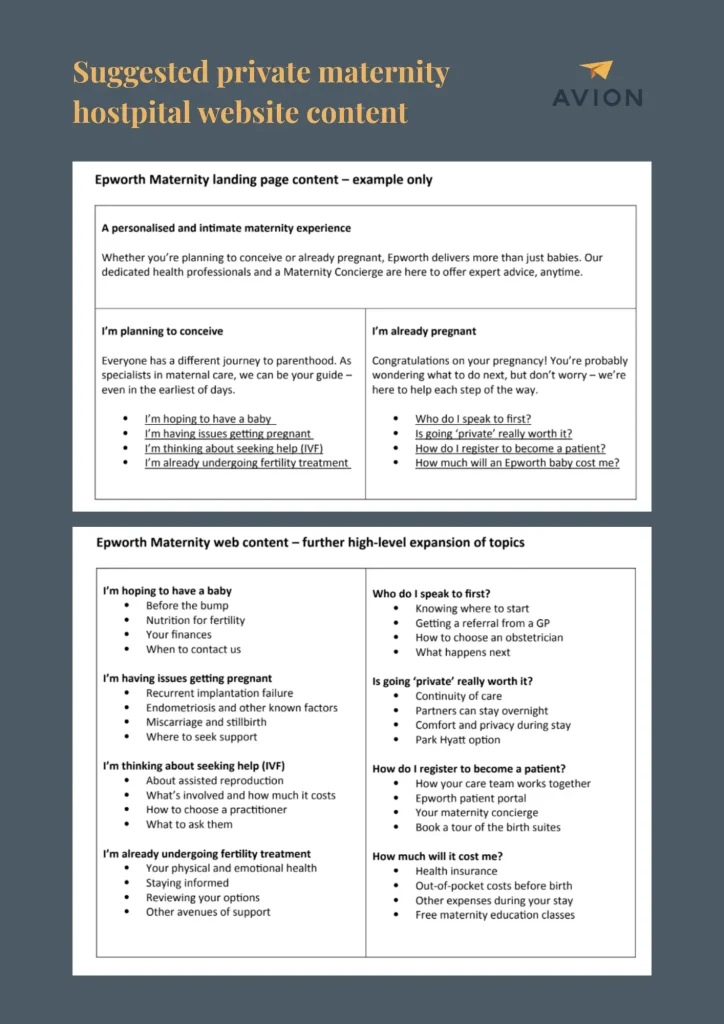
Here’s what I’d do instead. Rather than one generic “planning for your pregnancy” page, I’d structure the content around where a patient actually is right now – “I’m hoping to have a baby,” “I’m having issues getting pregnant,” “I’m already undergoing fertility treatment,” “I’m already pregnant” – and let each of those paths go deep on the specific, real questions that come with it, like:
- recurrent implantation failure
- whether going private is worth it
- how much it’ll actually cost
- what to ask a practitioner before choosing them.
Some of these prospective patients are already deep in their journey by the time they land on a hospital’s site. Meeting them at “here’s what a hospital is” instead of “here’s what your specific situation needs” is why so much healthcare content gets skimmed and forgotten.
This isn’t only a content problem, either. Structuring a homepage around where a patient actually is (as opposed to hospital departments or services) is an information architecture decision, not a copywriting one. It changes what gets built, not just what gets written.
If I had to choose a winner of the three, I’d say St Vincent’s does the best job – at least it opens with the patient’s circumstance as a heading: “You’re pregnant, where to from here?”
I’ve mocked up what that restructure could look like for Epworth below.
If the care Epworth gave me was five-star, the information I could access on the way there wasn’t. That gap is entirely fixable – and it’s a much smaller lift than people think.
Why content matters more than ever right now
Most content strategy conversations are about growth, conversion, visibility. This one isn’t, not really. This is about a person doing round two of IVF this year who’s going to spend tonight the way I spent hundreds of nights: Searching, comparing, trying to work out if what’s happening to her is normal. They’re going to ask an AI assistant instead of a forum. And whatever answer it gives them, shaped by whatever content exists to draw from, is going to sit alongside a decision that could change the entire course of her life.
| If you’re a health organisation looking to improve your visibility, read our article “A smarter way to show up in AU search” featuring real examples from Beyond Blue and The Better Health Channel. |
Providers get to decide whether the content that shapes that moment is theirs or whether it’s generic enough that the gap I fell into in 2021 is still there, just with ChatGPT standing in front of it instead of a search bar.
The difficult part for anyone running a marketing function is that this is harder to measure than a click.
You can’t always see when your content gets pulled into someone’s answer instead of your homepage. But that doesn’t make it less real. It makes it a harder problem to ignore, not an easier one to deprioritise.
I didn’t have ChatGPT when I needed it. But people on their own health journey now do. The only real question left is whether the people who actually know these circumstances bothered to write anything worth finding.
If this is a gap you recognise in your own patient content, we’d like to hear about it. Get in touch with Avion.
Image credit: Illustration by redgreystock on Magnific.

About the author
Natalie is a content strategist and co-founder of Avion, helping organisations shape clear, consistent brand narratives in an AI-driven world.
Recent articles

The next war isn’t about oil, it’s about land for data centres
The future of AI isn’t just about smarter models. It’s about the infrastructure behind them.

The real reason enterprise website projects run over budget
It’s rarely scope creep. Budget overruns on enterprise websites usually trace back to one thing: when content decisions get made.
Why content teams can’t hire their way out of delivery problems
When content delivery stalls, hiring can look like the obvious fix. But it often misses the real problem.

Our hot takes, straight to your inbox
Subscribe and join hundreds of readers just like you.